Field Station / Rajasthan: A Coliving Residency to Build the Parallel
A parallel society experiment with Zu-Grama
Logos

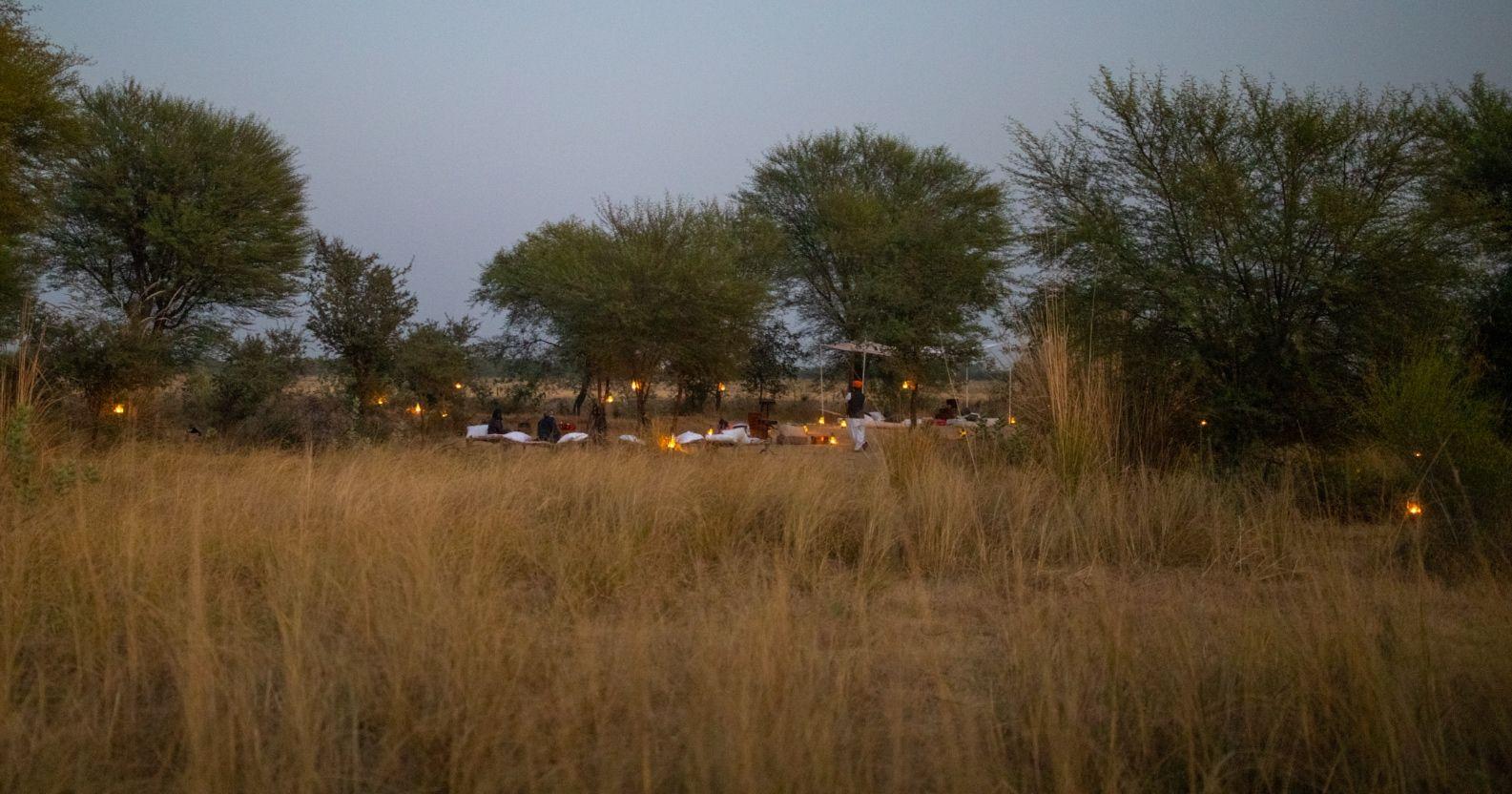
Field Station is deliberately different from a conventional hackathon. There is no conference centre to arrive at in the morning and leave at the end of the day. Residents will live, share meals, and build together on a 500-acre regenerative living project, working alongside people from different disciplines and testing what they create against real local problems.
More than a hack space
Most hackathons compress collaboration into a weekend. Participants form a team, build quickly, present something, and then go home. Field Station explores what happens when people spend longer together and share more than a workspace.
Residents will cohabit the site, with accommodation and meals provided. Days will combine focused build time with workshops, mentoring, and stand-ups. Outside those sessions, life at Dhun becomes part of the programme too: shared farm-to-table meals, walks, foraging, field lunches, and phone-free communal evenings.
That is intentional.
Building resilient communities is not only a technical problem. It also depends on trust, cooperation, and the everyday habits that allow groups of people to coordinate efficiently. Field Station creates space to experiment with both at once.
Instead of talking abstractly about new forms of social organisation, residents will spend eight days living them.
Proof, not hype
The same principle applies to what gets built. Field Station is centred on working solutions rather than speculative pitches. Builders are encouraged to arrive with something concrete, such as an existing project, prototype, experiment, or clearly scoped problem, and spend their time at the residency tailoring it to solve a previously identified, real issue affecting the communities surrounding the event’s site.
One of the residency’s civic challenges, for example, asks builders to explore better ways of reporting and responding to everyday local issues: water, waste, access, maintenance, and other problems that need to move visibly from “reported” to “in progress” to “resolved”.
Another focuses on privacy-preserving mutual aid: tools that can help residents and site staff coordinate things they actually need, from transport and supply runs to skills and practical help.
These are deliberately ordinary problems.
Infrastructure only matters when somebody actually uses it. A coordination tool becomes interesting when people coordinate with it. A reporting system proves itself when somebody reports a real problem, and someone else acts on it.
At Field Station, the environment is not just a backdrop for building. It directly informs what gets built.
Four ways to take part
Residents can apply through four tracks.
Logos Civic Prize Track
Builders in the Civic Prize Track will work on specific, live problems identified through Logos Circles and adapted to the local setting.
The initial challenges focus on civic reporting, community response, and privacy-preserving mutual-aid coordination. Teams will be able to use the Logos stack to create tools that can be piloted during the residency rather than disappearing after demo day.
Logos Sovereignty and Privacy Track
This track is for people already building tools, applications, and protocols that put greater control over data and infrastructure into their users' hands.
Participants can bring an existing work in progress or a well-scoped idea and develop it using Logos's private-by-default infrastructure. Projects might address the needs of Dhun, Jaipur, a participant's own community, or the wider Logos network.
The important part is having a credible path from idea to something people can run, test, and use.
Zu-Grama d/acc Track
Led by Zu-Grama, the d/acc track looks more broadly at technologies designed to preserve and strengthen human agency as AI and digital systems become more powerful.
Areas of interest include AI alignment and safety, AI for science, neurotechnology, biotech, collective intelligence, sense-making, civic technology, cryptography, governance, and other forms of d/acc-aligned infrastructure.
The track is intended for people with a serious question, project, or experiment that can move materially forward during the residency, particularly where collaboration across disciplines can produce something that would be difficult to achieve alone.
Resident, Non-Builder Track
Not everyone at Field Station writes code.
Activists, community organisers, artists, writers, testers, and explorers are also invited to apply. Their role is not peripheral to the experiment: technology that is meant to serve communities needs people ready to use it, challenge it, document it, and decide whether it is actually useful.
Non-builder residents will help dogfood projects, provide feedback, and participate in judging submissions. Artists and writers will also help bring a cultural element to the week, further distinguishing it from conventional hackathons that often consist entirely of whiteboards and terminals.
Why Dhun?
Field Station takes place in Dhun, Rajasthan, on a 500-acre regenerative living project, around 60–90 minutes from Jaipur International Airport.
The setting is deliberately removed from the usual conference or coworking environment. Residents will share accommodation; eat dishes prepared with locally available crops, grains, and nuts; and spend their evenings together rather than dispersing back to hotels.
There will still be plenty of time to develop projects. The daily rhythm includes stand-ups, mentoring, workshops, and more than four hours of uninterrupted build time. But the spaces between those sessions matter, too.
A conversation over lunch can change the direction of a project. Someone testing a tool over dinner can expose an assumption its builders missed. A problem noticed on the farm in the morning can become something a team starts solving that afternoon.
That continuity is one of the central experiments behind Field Station.
Build the parallel then test, use, and improve
The residency will culminate in a summit and demo night where participants show what they have built, what happened when people used it, and their next steps. Strong projects from the Logos tracks will also have the opportunity to unlock milestone-based grant funding to continue development.
But the goal is to test a different model for living and creating together.
Field Station brings technologists together with activists, artists, organisers, researchers, and users. Converging in an environment where problems are tangible, they’ll eat together, test things, break them, fix them, iterate based on how real people use them, and leave with more than a slide deck.
Field Station / Rajasthan runs from 23–31 October 2026 at Dhun, Rajasthan. Applications are open from 11–26 September. Around 30 residents will be selected across the four tracks.
Apply now to Field Station / Rajasthan to build the parallel with Logos and Zu-Grama.
Discussion
Logos
Logos
G IRL
Logos
Logos
Logos
Logos
Logos
Logos
Logos
Logos
Logos
Logos