PriFi: Security and Privacy Against Transactional Hazards
Exploring two complementary protections against opportunism inside transactions and predation from outside them
Logos


Blockchains introduced unprecedented settlement guarantees by embedding rules into the infrastructure rather than relying exclusively on intermediaries' promises. However, as explored in previous articles in this series, securing settlement does not necessarily secure the transaction itself.
Drawing on ideas and research compiled by Logos cofounder Jarrad Hope, we can consider a transaction to comprise seven distinct links: discovery, diligence, negotiation, contracting, ordering, settlement, and enforcement. Each involves the exchange of information, the delegation of authority, or reliance on another actor's conduct. Vulnerabilities can emerge at any of these points, even when the final transfer of value is executed precisely as intended by the underlying protocol.

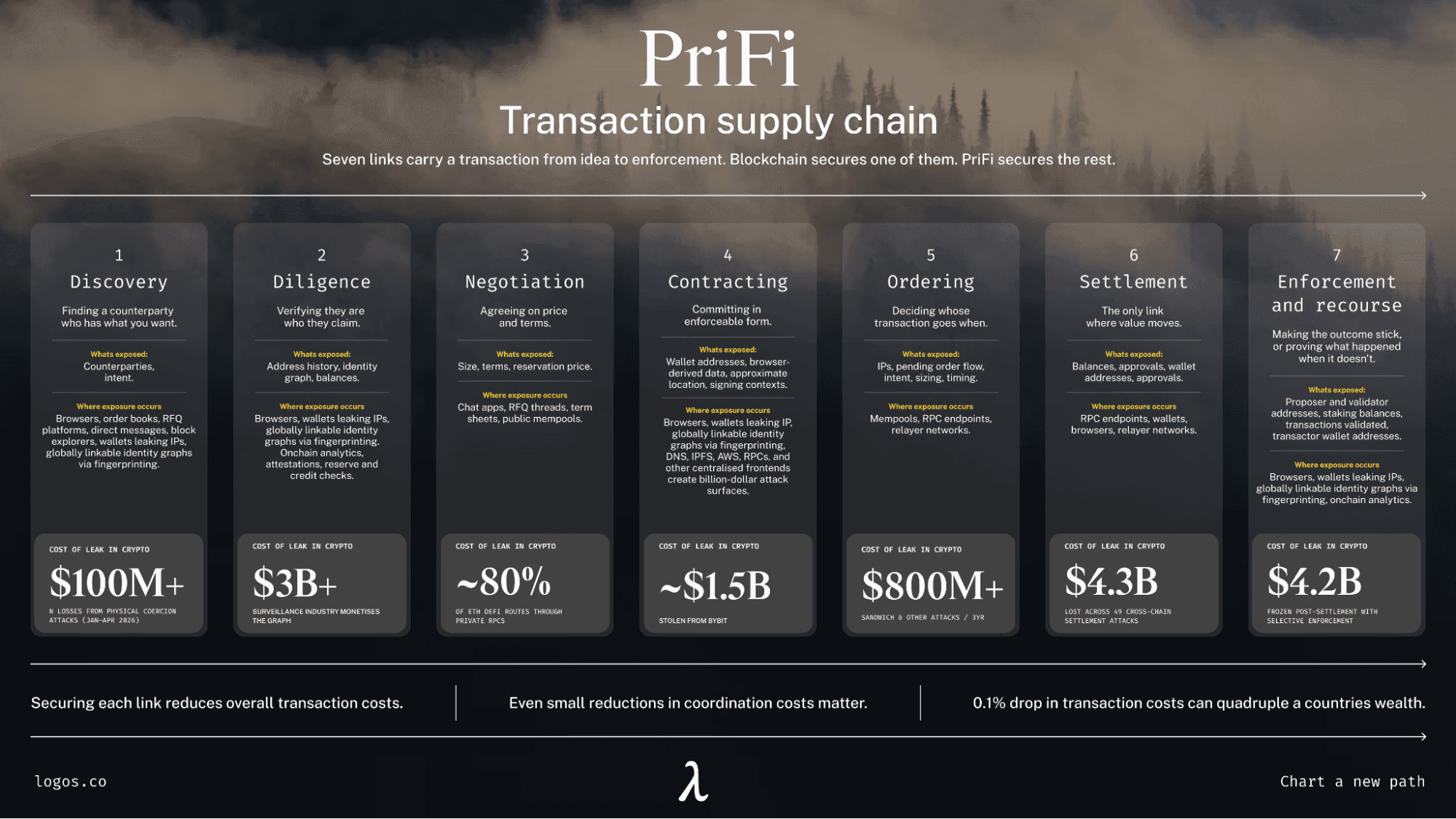
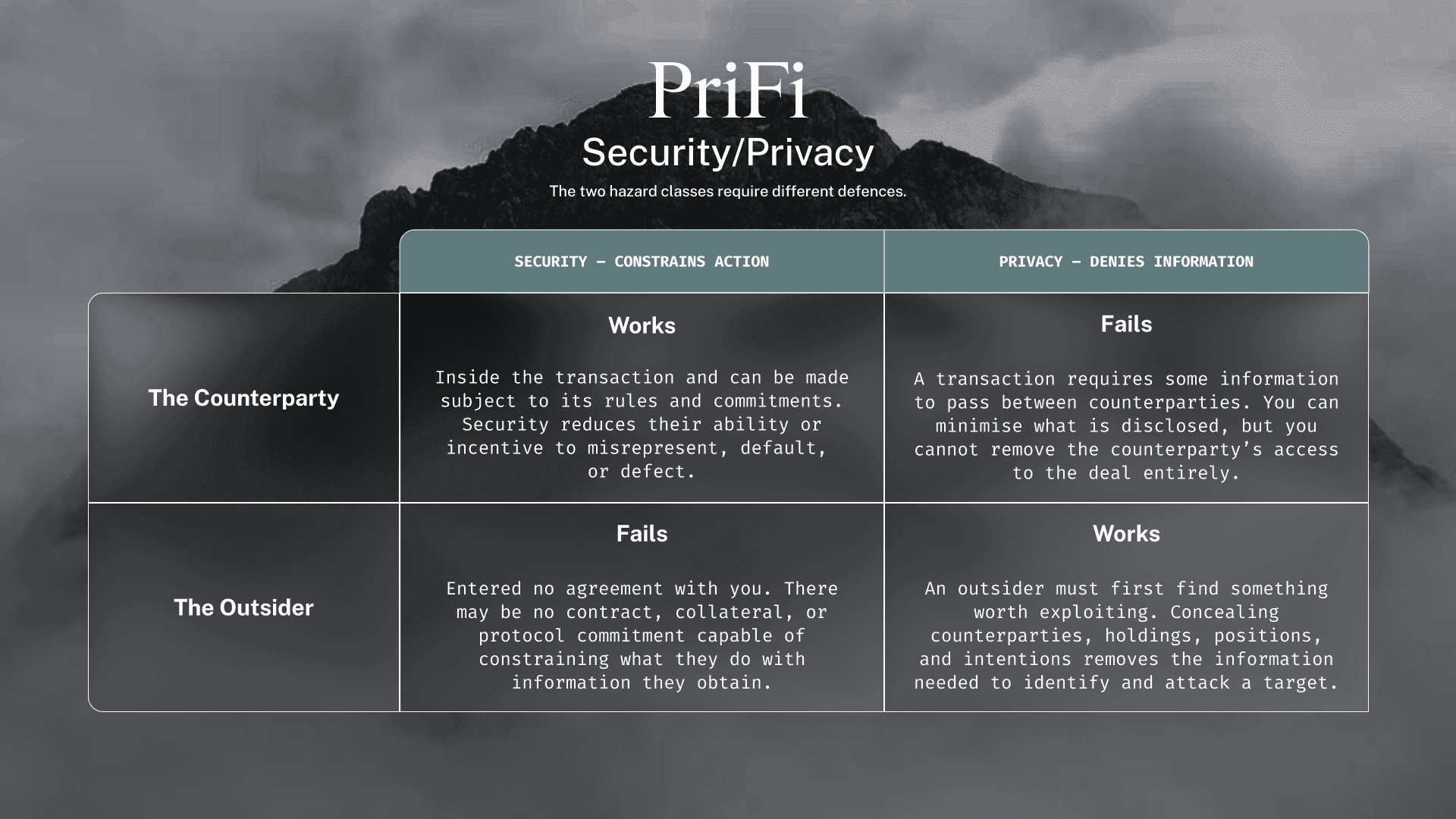
The third article in the PriFi series distinguished between two hazard classes. The first consists of actors inside the transaction, whose legitimate participation gives them access to information or capabilities they can exploit opportunistically. The second consists of outsiders who acquire information about a transaction and use it to identify opportunities for predation. Both threaten the potential gains from exchange, but the mechanisms through which they operate differ. Therefore, the appropriate protections must differ, too.
This article examines the two corresponding protections: security, which binds and deters those positioned to act against the transaction, and privacy, which limits the information available to actors who have no legitimate reason to possess it. It then considers why neither is sufficient on its own, and how combining them can strengthen the commitments underpinning private finance.

Security: Constraining opportunism inside the transaction
Exchange requires participants to place some degree of trust in one another. A lender must assess a borrower's ability to repay, a buyer must establish that a seller can deliver what was promised, and two parties negotiating a trade must disclose enough information to make an agreement even possible. These disclosures are necessary for exchange, but they also introduce exploitable vulnerabilities.
For example, a buyer might receive goods and subsequently refuse payment. A borrower might misrepresent the quality of their collateral. A counterparty entrusted with assets might exercise authority in a way that was never intended by the original agreement. In each case, the hazard emerges because the transaction grants somebody a position from which they can act against another participant.
Simply concealing information cannot eliminate this problem. A lender cannot assess a loan without learning something about the borrower, while a buyer cannot make an informed purchase without knowing something about the goods being offered. Instead, the problem is to make opportunistic behaviour sufficiently difficult, expensive, or unattractive, ensuring the transaction can proceed with reasonable confidence.
Making defection costly
Historically, commercial institutions have developed an extensive range of mechanisms for constraining opportunistic behaviour. Contracts create enforceable obligations, collateral places valuable assets at risk, escrow arrangements limit unilateral control over funds, and reputational consequences discourage misconduct among parties expecting to transact again. These mechanisms work by changing the incentives facing somebody who might otherwise defect.
Consider a landlord requiring a deposit from a tenant. The deposit does not physically prevent damage to the property. Rather, it increases the financial consequences of causing damage or failing to fulfil certain contractual obligations. The tenant retains the capacity to act opportunistically, but the expected cost of doing so rises.
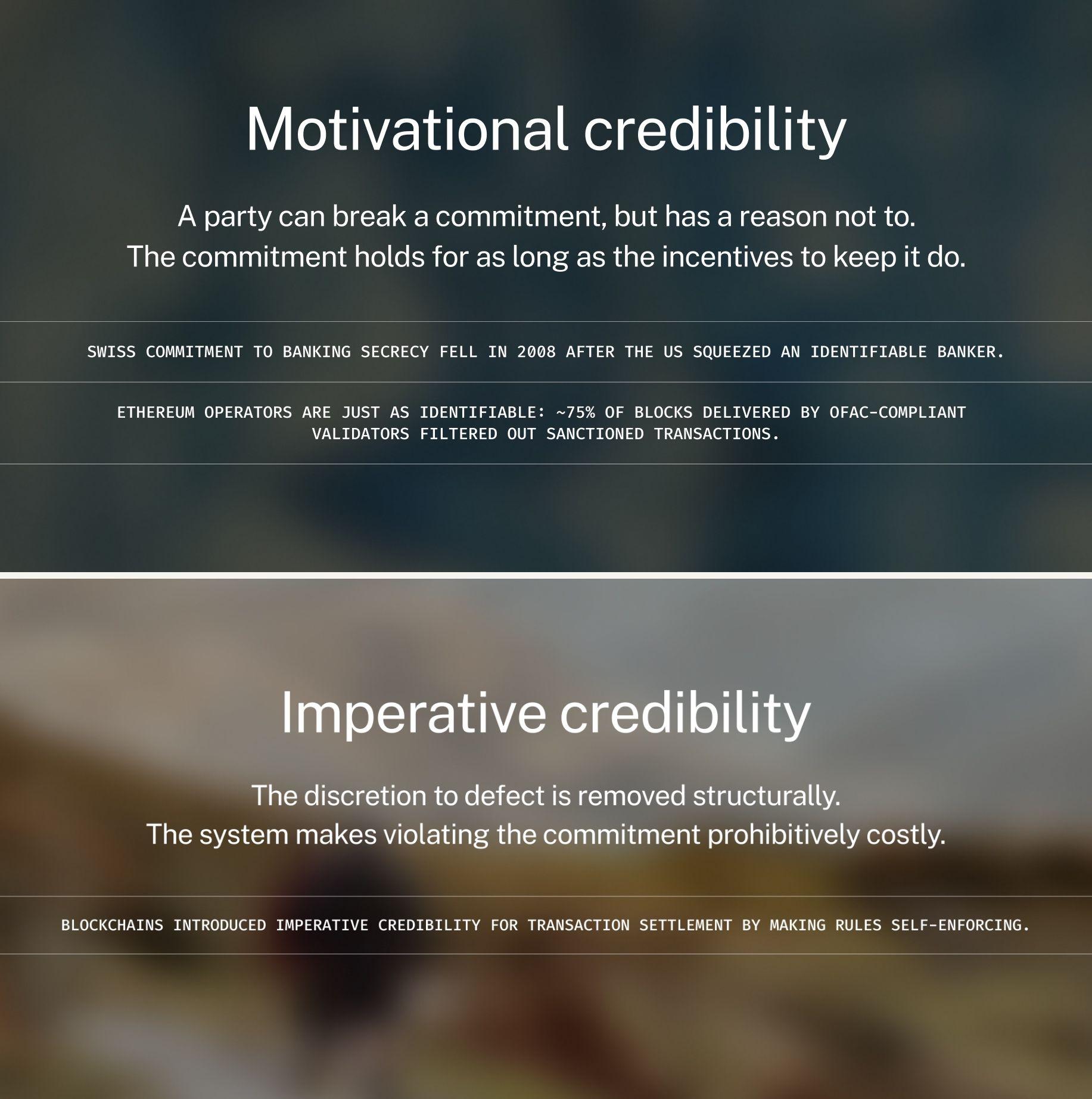
A similar principle applies to commercial performance bonds. A contractor undertaking a substantial project may be required to provide a bond that protects the customer against specified failures to perform. The bond does not guarantee that the contractor will complete the work, but it changes the allocation of financial risk and increases the consequences of underperforming. Such mechanisms create what previous articles in this series have described as motivational credibility. The actor retains the discretion to defect, but has reasons not to exercise it.
Their limitation is that those reasons remain contingent. If the gains from defection become sufficiently large, the probability of punishment sufficiently small, or the actor sufficiently indifferent to future consequences, opportunistic behaviour may still become attractive. Security must, therefore, consider an actor's capacity to defect and the likelihood that they can do so with impunity.
Removing discretion to defect
Cryptonetworks introduced another possibility: instead of making a prohibited action expensive, infrastructure can make particular actions impossible under the system's enforced rules.
Consider a transaction in which two parties wish to exchange different assets. Under a conventional arrangement, one party may have to transfer their asset first and trust the other to complete the exchange. This exposes the first participant to the possibility that their counterparty will receive the asset and refuse to reciprocate. An escrow service can mitigate the problem, but it introduces another actor whose conduct must itself be trusted or constrained.
Atomic swaps illustrate how some of this dependence can instead be addressed through protocol design. Maurice Herlihy's research into atomic cross-chain swaps describes mechanisms through which parties can coordinate exchanges without relying on a single participant's discretionary promise to complete their side of the trade. Using cryptographic conditions and time restrictions, protocols can be designed to structurally protect against specified forms of counterparty defection (Herlihy, 2018). Such architectures ensure that a counterparty cannot simply receive the other party's asset while disregarding the conditions governing the exchange. Rather than relying entirely on reputational or contractual consequences, the system constrains the actions available to participants.
This illustrates imperative credibility: certain commitments are enforced structurally rather than sustained exclusively through incentives. However, imperative credibility does not eliminate every possible hazard. Software defects, compromised signing processes, misleading interfaces, governance decisions, and operational dependencies can still create opportunities for exploitation. The protection applies to the actions actually constrained by the architecture, not to every circumstance surrounding the transaction.

Security should not be understood as a single mechanism applied at settlement. It requires identifying the capabilities each actor possesses throughout the transaction lifecycle, determining which could be abused, and reducing unnecessary discretion wherever possible. The architecture for enhancing security should, therefore, seek to limit the ability to defect, increase the costs of misconduct where discretion remains necessary, and reduce the opportunities to act without accountability.
Privacy: Preventing predation from outside the transaction
The second hazard class presents a different challenge. An external predator has not necessarily entered into an agreement with the participants. They may have accepted no contractual obligations, placed no collateral at risk, and developed no reputational relationship with the people whose transaction they intend to exploit. As a result, the mechanisms available for controlling opportunistic counterparties may be ineffective against them.
A contract cannot meaningfully bind an unknown observer who never agreed to its terms. Nor can a reputation-based mechanism reliably deter an attacker who can act anonymously, disappear afterwards, or operate beyond the reach of the institutions expected to punish them. Security may still limit an outsider's ability to attack, but there is another way to reduce the hazard: prevent them from acquiring the information necessary to identify the opportunity in the first place.
Information as an input for predation
As established in the previous article, an outside actor generally requires some combination of information, capacity, and impunity to exploit a transaction. Information allows the actor to identify a target or opportunity. Capacity determines whether they can act upon it. Impunity affects the expected consequences of doing so. These conditions offer a useful way to understand the economics of predation.
Consider a company preparing to acquire a competitor. If the negotiations remain confidential, outside traders may have no reason to anticipate the acquisition. Once information about the impending deal leaks, however, traders can potentially acquire shares before the announcement moves their price. The ability to trade existed all along, but information becoming available may alert observers to a particular opportunity.
Similar considerations apply in procurement, where revealing bids before an auction closes can allow competitors to respond strategically to information they would otherwise lack. William Vickrey's research into auctions and competitive sealed tenders provides an important foundation for understanding how auction rules shape bidder incentives and the use of information (Vickrey, 1961).
A sealed-bid auction deliberately restricts what participants know about competing offers. The objective is not to eliminate information from the transaction, but to control when and to whom it becomes available. Importantly, a conventional sealed-bid auction may still require trusting the auctioneer to preserve confidentiality. Researchers have consequently explored cryptographic auction designs in which a winning bid can be determined without revealing losing bids to either the auctioneer or other bidders (Peralta, Montenegro, & Lopez, 2013).
This illustrates the relationship between privacy and credible commitments. Concealing information from competitors reduces opportunities for strategic exploitation, while constraining the auctioneer's access to that information reduces dependence on their continued restraint. Both protections contribute to the integrity of the exchange, but they address different positions from which exploitation could occur.
When public information becomes the attack surface
Transparent blockchains make the informational dimension of predation particularly important. Transaction histories, wallet balances, contract interactions, and in many systems, pending transaction intentions can be observed by those with no relationship to the participants involved. This information may be valuable for verification, but it can also significantly reduce the cost of identifying targets.
Address poisoning illustrates the problem. In this attack, an adversary examines a wallet's transaction history and generates a new address that resembles one the wallet has previously interacted with. The attacker then attempts to introduce the deceptive address into the victim's transaction history, hoping that a future payment will be misdirected.
Chainalysis documented a May 2024 case in which approximately $68 million in wrapped BTC was transferred to an attacker-controlled lookalike address. The funds were subsequently returned, but the incident demonstrates how publicly available transaction information can support highly targeted deception (Chainalysis, 2024). The attacker did not need to compromise the blockchain's settlement rules. Instead, they exploited information about previous interactions and the user's reliance on transaction history when preparing a new transfer. This demonstrates an important limitation of privacy as a defence: preventing unnecessary exposure of information can reduce an attacker's ability to select and manipulate a target, but it does not eliminate the need for secure transaction verification.
The same pattern appears in decentralised trading. Philip Daian and others documented how bots exploit observable transactions and compete for favourable execution ordering when interacting with automated market maker decentralised exchanges. Their research demonstrated how transaction visibility and ordering discretion can create opportunities to capture value from other market participants, also known as MEV (Daian et al., 2020).
Consider an investor submitting a large token purchase to the blockchain. If the order is publicly visible before execution, another participant may be able to buy ahead of it, benefit from the resulting price movement, and sell afterwards. The investor's transaction may settle correctly under the protocol's rules, yet still deliver a worse economic outcome because information about the intended trade was known before settlement.
For such an attack, the adversary need not know the investor's real-world identity. The existence, size, and intended execution of the order may be sufficient. Privacy, therefore, concerns more than concealing personal information. It means limiting the disclosure of any information that gives unrelated actors an exploitable advantage.
Security and privacy: Complementary protections
The two protections target different hazards, but they should not be treated as independent alternatives. Security principally addresses what an actor can do and the consequences of doing it. Privacy principally addresses what an actor can know, and whether that knowledge enables them to identify an opportunity for exploitation.
| Security | Privacy | |
| Primary objective | Constrain or deter harmful actions | Prevent unnecessary exposure of exploitable information |
| Principal hazard | Opportunism by actors with access or authority | Predation by actors outside the exchange |
| Main mechanism | Rules, permissions, collateral, penalties, and enforcement | Confidentiality, encryption, selective disclosure, and metadata protection |
| Economic effect | Raises the expected cost or reduces the feasibility of defection | Raises the cost of identifying and targeting opportunities |
| Principal limitation | Cannot prevent every attack enabled by widely available information | Cannot prevent misconduct by actors who necessarily possess privileged information |
| PriFi objective | Reduce discretionary powers and strengthen commitments | Minimise unnecessary information exposure across the transaction lifecycle |
These mechanisms do not map perfectly onto the two hazard classes. An outsider's ability to act can be constrained by security mechanisms, while privacy can also protect sensitive information from counterparties. Nevertheless, the distinction helps establish where each protection is most economically useful.
A counterparty who must receive information to complete an exchange cannot simply be denied all access. Their behaviour must also be constrained. Conversely, the best defence against an outside observer with no legitimate need to know about the transaction may be to prevent the information from reaching them at all. The difference becomes especially clear when either protection is applied in isolation.
Security without privacy
Imagine an institution holding a substantial quantity of digital assets in a wallet protected by multiple independent signatures. Its authorisation structure may make unilateral theft extremely difficult. No single actor has sufficient authority to move the funds, and the underlying blockchain will reject transfers that do not meet the wallet's execution conditions.
However, if the institution's holdings, transaction patterns, and operational relationships are publicly observable, outside actors may still acquire useful information about where to concentrate their efforts. They might target signatories with phishing attempts, monitor operational patterns, or attempt to compromise systems involved in preparing transactions. The security controls remain valuable, but the information available to attackers can make those controls more expensive to maintain.
Privacy without security
Now consider the reverse. A financial institution moves its transactions into a confidential environment, shielding counterparties, balances, and trading intentions from public observation. However, the service provider maintaining that environment retains unrestricted access to transaction information and possesses the authority to alter, delay, or disclose it. The institution has reduced exposure to unrelated outsiders, but has concentrated privileged information and discretion in a new actor. The security of the transaction depends on that actor continuing to exercise its authority appropriately.
As the second article in this series argued, this remains a motivational commitment. The provider may have strong commercial and legal incentives to behave correctly, but the ability to defect has not necessarily been removed. The result is privacy from the public without equivalent protection against an insider. Neither outcome is sufficient for an infrastructure-design philosophy seeking to minimise both the risk of exploitation and the costs of mitigating that risk.
Revealing what is necessary without exposing everything else
Combining security and privacy creates a new challenge: legitimate transactions require certain information to be disclosed. A lender needs assurance that collateral exists. An exchange needs to establish that assets are available for transfer. A regulator or auditor may need evidence that particular obligations have been satisfied. Absolute privacy would make some of these activities impossible or introduce significant new risks of misrepresentation.
The objective is, therefore, not to conceal everything, but to distinguish the information required to perform or verify a legitimate function from information exposed merely because the underlying infrastructure makes it observable. Modern cryptography offers mechanisms for making this distinction more practical.
Zero-knowledge proofs, for example, allow one party to demonstrate that a particular statement is true without revealing the underlying information used to establish it. The US National Institute of Standards and Technology describes this as a way for a prover to convince a verifier of a statement without disclosing additional information beyond its truth (NIST, n.d.).
Consider a borrower seeking to establish that they satisfy a collateral threshold. In a conventional arrangement, the lender may request detailed records showing the borrower's assets. In a suitably designed cryptographic system, it may instead be possible to prove that specified assets satisfy the required threshold without disclosing every holding or transaction in the borrower's financial history. The lender receives evidence relevant to the agreement, while unrelated information can remain concealed.
This does not eliminate the need to verify that the assets are genuinely controlled by the borrower, correctly valued, and available as collateral. Nor does it remove the possibility of risks beyond the particular statement being proved. However, it demonstrates that verifiability and universal information disclosure need not be the same thing.
Other techniques, including encrypted communications, cryptographic commitments, secure multiparty computation, and selective disclosure, offer different ways to distribute information according to the needs of a transaction. Each addresses a particular problem. Encryption can protect communications from observers without necessarily hiding who is communicating. A commitment can fix a value without immediately revealing it, although the value may subsequently need to be disclosed. Secure multiparty computation can enable participants to evaluate certain functions over private inputs without revealing those inputs to one another.
The broader design opportunity is to provide the information necessary for an exchange while reducing the additional exposure created by the infrastructure carrying it out. For PriFi, the goal is to make transactions appropriately verifiable without making every commercially sensitive detail available to every observer.
Protecting the entire transaction supply chain
The distinction between security and privacy becomes more useful when applied across the seven links of the transaction lifecycle. During discovery, privacy can prevent a participant's search for counterparties from revealing commercially valuable intentions to unrelated observers. Security, meanwhile, can provide mechanisms for authenticating participants and reducing the likelihood of fraudulent introductions.
During diligence, selective disclosure and cryptographic proofs can limit the information participants must surrender, while verification and enforceable obligations help address misrepresentation.
During negotiation, confidential communications protect bargaining positions from outside exploitation, while agreed procedures and authenticated messages can reduce opportunities for manipulation or disputes over what was communicated.
During contracting, cryptographic commitments and digital signatures can make agreed-upon terms verifiable, while access controls can reduce the unnecessary disclosure of those terms.
During ordering, concealing pending transaction intentions can reduce opportunities for frontrunning, while mechanisms that constrain the discretion of those responsible for sequencing transactions can address another potential source of exploitation.
At settlement, protocol-enforced validity conditions can prevent unauthorised state transitions, while privacy-preserving transaction designs can reduce unnecessary disclosures concerning balances, counterparties, and asset movements.
Finally, enforcement may require verifiable evidence of agreed obligations and mechanisms for resolving disputes, without necessarily publishing the parties' complete financial relationships.
These examples demonstrate why securing an individual blockchain function is not equivalent to securing the transaction. If discovery exposes an investor's intentions, private settlement may come too late to protect them from strategic responses. If negotiation is confidential, but the application used to prepare a transaction can substitute malicious instructions, privacy will not prevent an unauthorised outcome. If settlement conceals balances but a central infrastructure provider can observe every request, the exposure has merely been relocated.
Protection must instead be evaluated across the entire lifecycle, considering both the actors capable of exploiting a position and the information that makes the position economically valuable.
PriFi as an architecture of security and privacy
PriFi brings these two approaches together by treating transactional protection as an architectural problem rather than something that can be addressed exclusively through individual applications or voluntary institutional promises. The objective is to reduce two related dependencies: reliance on actors choosing not to misuse their capabilities, and reliance on unrelated observers choosing not to exploit information they can access.
The first can be addressed through security mechanisms that constrain authority, distribute permissions, and make misconduct more difficult or costly. The second can be addressed through privacy mechanisms that minimise unnecessary disclosure of information and reduce the number of actors who can observe sensitive activity. This is consistent with the broader objective of Logos, whose architecture combines locally operated applications with privacy-preserving networking, messaging, storage, and blockchain infrastructure.
A locally operated application can reduce reliance on hosted infrastructure that can observe or control interactions. Privacy-preserving communications can limit the information exposed while participants coordinate, while protocol-level rules can constrain the subsequent movement of assets. None of these mechanisms provides complete protection on its own. Their value comes from reducing various vulnerabilities that arise as a transaction moves from coordination to execution.
Muster, the experimental application built with the Logos stack and introduced in previous articles, provides a practical setting for examining these dependencies. Making visible the information disclosed during transactional coordination and the infrastructure involved helps distinguish where confidentiality is preserved, where authority remains concentrated, and where participants still depend on other actors' conduct.
The broader question is whether these dependencies can be progressively reduced through architectural design. Protecting financial transactions requires more than making promises about intermediaries' behaviour. It also requires considering which actors should possess particular information or capabilities in the first place.
PriFi: Securing transactions structurally
The economic importance of security and privacy extends beyond preventing individual attacks. When participants face uncertainty about whether counterparties will honour agreements, they incur costs to manage that uncertainty. They may require collateral, insurance, intermediaries, extensive diligence, or more complex contractual arrangements.
When they face the additional risk that outside actors can observe and exploit their activity, they may incur further costs to conceal their intentions, protect operational information, or avoid exposing valuable positions. Some participants may ultimately decide that the combined risks and mitigation costs outweigh the expected benefits of transacting at all.
Security and privacy can reduce these barriers through different mechanisms. Security strengthens confidence that actors granted access or authority cannot easily abuse their positions. Privacy reduces the number of external actors who can discover and exploit opportunities created by the transaction. Their combined effect is to reduce the expected cost of transactional hazards, potentially enabling exchanges that would otherwise be too risky or expensive to undertake.
Blockchain demonstrated that the rules governing settlement can be enforced without requiring participants to place unrestricted trust in a central operator. PriFi builds on that by asking how similarly credible protections can be extended across the information flows, relationships, and dependencies surrounding settlement.
The objective is not absolute privacy, nor the elimination of every possible risk. It is to ensure that the information and authority required for exchange are distributed only as far as necessary, and constrained wherever possible.
Explore Logos PriFi infrastructure / Run Muster through Logos Basecamp / Read more about the transaction supply chain
This article is based on research compiled by Logos cofounder Jarrad Hope and ideas emerging from it. PriFi is central to Logos’ mission to revitalise civil society. Effective parallel organising requires economic rails that can withstand outside efforts to obstruct and manipulate activity.
Selected references
Chainalysis (2024), “Anatomy of an Address Poisoning Scam”.
Daian, Philip, Steven Goldfeder, Tyler Kell, Yunqi Li, Xueyuan Zhao, Iddo Bentov, Lorenz Breidenbach, and Ari Juels (2020), “Flash Boys 2.0: Frontrunning in Decentralized Exchanges, Miner Extractable Value, and Consensus Instability”, 2020 IEEE Symposium on Security and Privacy.
Herlihy, Maurice (2018), “Atomic Cross-Chain Swaps”, Proceedings of the 2018 ACM Symposium on Principles of Distributed Computing.
National Institute of Standards and Technology (n.d.), “Zero-Knowledge Proof”, Computer Security Resource Center Glossary.
Peralta, Rene C., Jose A. Montenegro, and Javier Lopez (2013), “Secure Sealed-Bid Online Auctions Using Discreet Cryptographic Proofs”, Mathematical and Computer Modelling.
Vickrey, William (1961), “Counterspeculation, Auctions, and Competitive Sealed Tenders”, The Journal of Finance, 16(1), 8–37.
Williamson, Oliver E. (1983), “Credible Commitments: Using Hostages to Support Exchange”, American Economic Review, 73(4), 519–540.
Williamson, Oliver E. (1985), The Economic Institutions of Capitalism (New York: Free Press).
Williamson, Oliver E. (1996), The Mechanisms of Governance (Oxford: Oxford University Press).
Discussion
Logos
Nenad
Nasrudin
Logos
Logos
Logos
Logos
Logos
Logos
Logos
Logos
Logos